Gold-standard diagnostic technology: advantages and health value of forearm Dual energy X-ray absorptiometry bone densitometer
Feom: 品源医疗AddDate: 2026-5-25Views: 65
When it comes to osteoporosis, most people still rigidly regard it as an elderly problem caused by aging. However, in recent years, with changes in lifestyle—sedentary behavior, dietary imbalance, prolonged sleeplessness, and chronic psychological stress becoming the norm—bone mass loss and declines in bone mineral density have become increasingly common, and osteoporosis is quietly showing a trend toward younger ages.
In many individuals, early bone loss presents with little subjective symptoms, and only when persistent low back pain occurs, minor bumps lead to fractures, or even short stature and a stooped posture emerge is irreversible skeletal damage recognized. According to the China Osteoporosis Prevention and Treatment Guideline (2022) statistics, the prevalence of osteoporosis among women aged 50 and above in our country is relatively high, and the number of younger individuals with low bone mass continues to rise year by year. Bone density screening has thus become a health screening item that cannot be ignored across all age groups.
Among various bone density assessment methods, dual-energy X-ray absorptiometry (DXA) is internationally recognized as the gold-standard measurement. Its stable and precise data are widely used in clinical skeletal evaluation. For forearm assessments, the forearm dual-energy X-ray bone densitometer uses dual-energy X-ray scanning to estimate bone mineral content, enabling precise assessment of bone hardness and resistance to impact. Even in obese populations or those with implants post-surgery, stable and objective data can be obtained. Scanning takes only a few seconds and clearly presents bone density indices and the degree of bone loss, providing reliable data support for fracture risk assessment, clinical diagnosis, and rehabilitation outcome monitoring.
Conventional dual-energy X-ray bone densitometry devices largely target the lumbar spine and hip, are bulky, and require the examinee to lie supine and be immobilized during testing, which is not friendly to those with limited mobility. Forearm dual-energy X-ray absorptiometry densitometers optimize the assessment mode, balancing safety and comfort, and fit a broader range of people:
1. Low-dose radiation, safe and gentle: The device employs low-dose detection technology, with an extremely low radiation dose per examination, minimizing screening burden, and suitable for regular rechecks and repeated screenings across populations including women, young adults, and the elderly.
2. Simple operation, comfortable positioning: No need to lie flat or be restrained; the examinee simply places the forearm to complete the scan, and the procedure is straightforward and convenient. It is particularly friendly for elderly individuals with limited mobility, post-rehabilitation patients, and frail individuals, reducing discomfort during the examination.
3. Compact size, flexible deployment: No dedicated lead room required, occupying little space. It can be integrated into hospital clinics, community health centers, professional health examination facilities, wellness centers, and other settings, meeting routine mass health screening needs.
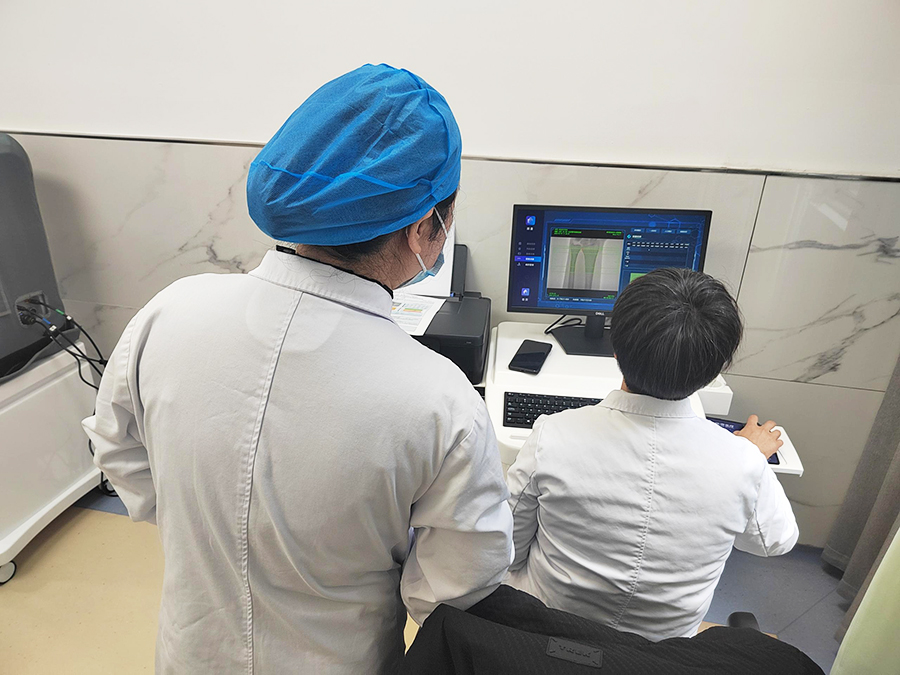
The significance of bone density assessment lies not in merely viewing a set of data, but in providing a scientific basis for skeletal health management. After forearm DXA is completed, a clear and intuitive professional report is generated; the indicators are presented in an accessible manner, facilitating understanding of skeletal health by both healthcare professionals and examinees.
Healthcare professionals can interpret the results to distinguish among normal, low bone mass, and osteoporosis, and, in conjunction with individual lifestyle and health status, formulate personalized conditioning plans. From daily calcium supplementation and scientifically guided exercise to nutrient supplementation and specialized medical interventions, targeted maintenance can be achieved.
Once bone mass is lost, it is difficult to regenerate. Skeletal health has never been an exclusive concern of the middle-aged and elderly; it is a lifelong maintenance priority. By discarding the notion that osteoporosis is merely an elderly disease and by valuing routine bone density screening, one can proactively mitigate skeletal risks.
Forearm dual-energy X-ray absorptiometry, anchored in established gold-standard detection technology, offers precision, safety, and convenience, and is adaptable to multiple health-screening scenarios, covering youth, middle age, and older adults. Using gentle, professional medical testing methods, it detects subtle skeletal changes and safeguards public skeletal health.